FCT digital services
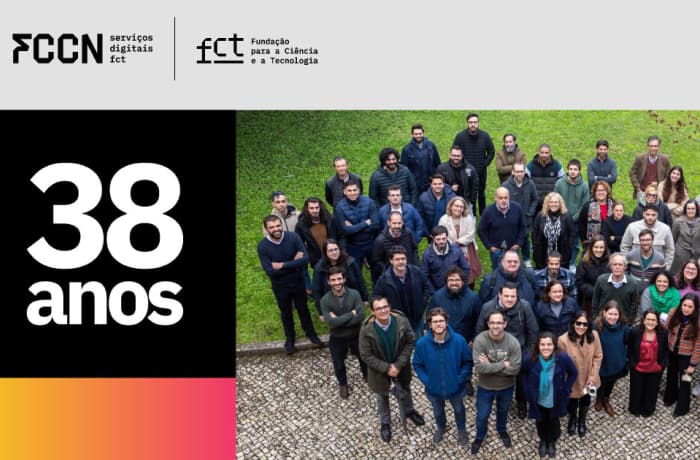
FCCN celebrates 37 years and promotes science through... PTCRIS, CIÊNCIAVITAE and SCIENCE ID.
Learn about or relive the journey of FCCN, the digital services of the Foundation for Science and Technology, in Portugal. A journey marked by milestones focused on fostering technology for knowledge at a national level.
On December 23, 1986, the Foundation for the Development of National Scientific Calculation Resources was founded, which would later give rise to the FCCN. The foundation's objective, explained in an article published a few months later, was to "promote the installation and use of powerful calculation resources and to connect them with scientific and technical institutions, particularly in higher education."
As a first step, in 1988, the FCCN included in its activity plan the foundations for the establishment, in Portugal, of the National Scientific Calculation Network (RCCN), the predecessor of the current RCTS. Also this year, the first supercomputer to serve the FCCN was created – the CONVEX C220.
The autumn of 1991
One of the key steps would be taken five years later, in the fall of 1991. It was on this date that the "RCCN IP Service" project, developed by FCCN, achieved its main objective – connecting Portugal to the Internet. "This project originated from a proposal formulated by a group of researchers called "Forum-IP," explains José Legatheaux Martins, who led this project. on a website he created about the history of the Internet in Portugal.
On this website, Legatheaux Martins shares several documents and technical details about Portugal's first steps online, also detailing the phase of “setting up the DNS domain of Portugal – known as “.pt” – between 1991 and 1994.
Thus, during the early 1990s, the FCCN enabled the main national institutions of basic and higher education to have access to the Internet. However, the Internet was still unknown to the general public. To address this, in 1994, the organization organized the seminar "Portugal on the Internet" at the National Civil Engineering Laboratory, which represented one of the first public presentations of this technology in our country.
In 1995, GigaPix was created, a neutral, non-profit Portuguese traffic exchange point, with the aim of improving the quality of IP network interconnection in Portugal. Then, in 1997, FCCN allowed the start of internet provision to all schools in the country, with RCTS ensuring this connection to 1650 schools, from 5th to 12th grade.
The first decade of the new millennium
In the first decade of the new millennium, FCCN's focus was on the transition to fiber optics, cybersecurity, and the European integration of national connectivity.
In 2002, the creation of CERT.PT, which emerged with the mission of responding to security incidents. 2003 was the year in which FCCN became connected to the European GÉANT network. Already in 2004, the b-on – Online Knowledge Library, the service of Video broadcasting Fiber Optics was implemented at RCTS. The following year, Eduroam and RCTS VoIP services began.
The most recent years of evolution
Over the years, they were created more digital services that now reach more than 600,000 students, researchers and teachers belonging to the national Teaching and Research community every day.
Within the areas of Connectivity, Computing, Collaboration, Knowledge, Security and Innovation: there are already more than 20 digital services that FCT, through FCCN, brings to its community.
In this more recent period, the highlights are emergence of Arquivo.pt and Open Access Scientific Repository of Portugal Open Access Scientific Repositories of Portugal ((RCAAP)), in 2007 and 2008, respectively.
In 2009, the multimedia area was also reinforced, with the start of the desktop video conferencing (Colibri), the e-learning support service (educast) and opening of the Studio.
In 2012, FCCN became part of the Foundation for Science and Technology (FCT), a public foundation under private law. From this point on, other services emerged, as the PTCRIS, CIÊNCIAVITAE and SCIENCEID, the platform SHIP or the National Advanced Computing Network.
The evolution is undeniable, and throughout its nearly four decades of existence, FCCN has guided its activities by the same mission: to provide the best to the national scientific community, providing dozens of services to thousands of users. Click here to learn more about the history of this entity: https://www.fccn.pt/quem-somos/historia/
Publicado em July 24, 2024